
Soldiers with profiles may be exempt from certain ACFT events or may have alternative events that they can perform to demonstrate their physical readiness. The goal is to provide an equitable assessment of fitness while accommodating individual capabilities. For instance, a soldier with a lower-body injury may be exempt from the two-mile run but could be required to complete a modified version of the sprint-drag-carry event.
 As soldiers engage with the ACFT and utilize the score calculator, they not only enhance their personal fitness levels but also contribute to the overall readiness and effectiveness of the Army. By providing a comprehensive evaluation of soldiers’ physical capabilities, it fosters a culture of fitness and readiness while ensuring fair and equitable assessment standards. Embracing this new fitness paradigm is essential for soldiers aiming to excel in their military careers and meet the demands of modern combat. In conclusion, the ACFT score calculator is a pivotal tool in the Army’s approach to physical fitness assessment.
Moreover, the ACFT emphasizes functional fitness, focusing on movements and exercises that soldiers are likely to encounter in real-world scenarios. This shift in focus helps prepare soldiers for the physical demands of combat, ultimately enhancing their effectiveness on the battlefield.
By incorporating a diverse range of physical competencies and adopting a gender-neutral approach, the Army aims to enhance readiness and performance in an increasingly complex operational environment. As soldiers adapt to the new standards, the focus on comprehensive fitness will likely lead to a more capable and resilient force, ready to meet the challenges of modern warfare. In conclusion, the 2026 Army ACFT score table represents a significant advancement in the assessment of soldier fitness.
The ACFT is designed to be inclusive, recognizing that soldiers may have physical limitations due to injuries, medical conditions, or other factors. This profile is essential for ensuring that soldiers are evaluated fairly and that their scores reflect their true physical readiness. The Army provides a framework for soldiers to obtain an ACFT profile, which is a formal documentation of their physical capabilities and limitations.
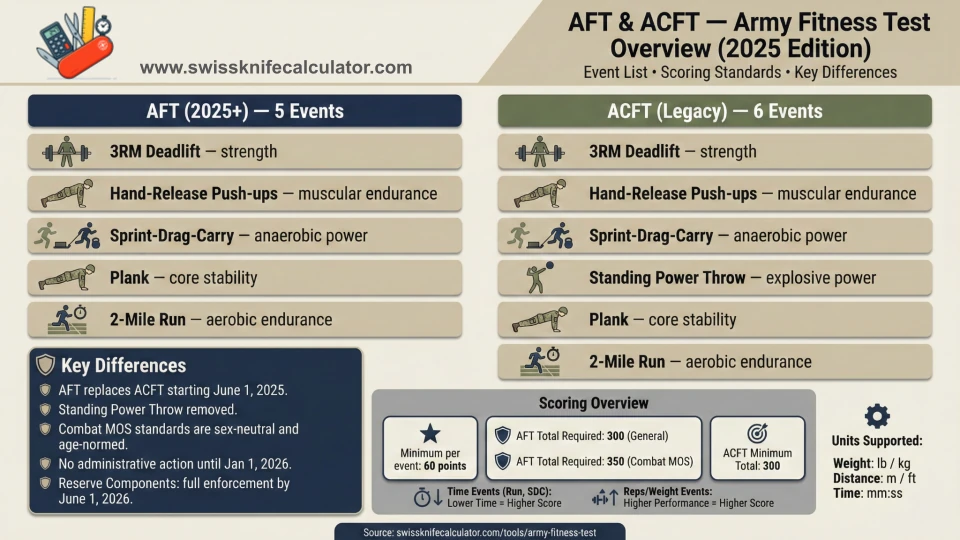
This test aims to better reflect the physical demands of combat and operational tasks, promoting a culture of fitness that aligns with the Army’s mission. The ACFT was introduced as a more comprehensive assessment of soldiers’ physical readiness, moving away from the traditional Army Physical Fitness Test (APFT). The acft 2026 score consists of six events: the deadlift, standing power throw, hand-release push-up, sprint-drag-carry, leg tuck (or plank), and a two-mile run.
Additionally, the Army has been proactive in addressing the needs of soldiers with varying physical capabilities. This trend is likely to continue, with further adaptations made to ensure that all soldiers can meet the standards while still being held accountable for their physical readiness. As of 2023, the introduction of alternate events for the leg tuck, such as the plank, has provided more options for soldiers to demonstrate their fitness.
For instance, if a soldier performs a deadlift of 200 pounds, the calculator would reference the scoring scale for that event, assigning a corresponding score based on the weight lifted. To use the ACFT score calculator, soldiers input their performance metrics for each event. This process is repeated for each of the six events, with the final score being the sum of all individual event scores.
 Incorporating rowing, cycling, and swimming into a fitness routine can provide a well-rounded approach to aerobic conditioning. Each of these activities offers unique benefits, and alternating between them can help prevent burnout and overuse injuries associated with a single type of exercise. For individuals looking to improve their overall fitness, a balanced regimen might include:
Designed to evaluate the physical readiness of soldiers for combat, the ACFT replaces the previous Army Physical Fitness Test (APFT) with a more comprehensive approach. Central to this evaluation is the ACFT score calculator, a tool that allows soldiers to assess their performance across various physical fitness components. This article will delve into the mechanics of the ACFT score calculator, its components, and its implications for soldiers and the Army as a whole. Army assesses the physical fitness of its soldiers. The Army Combat Fitness Test (ACFT) has been a significant shift in how the U.S.
The scoring for soldiers with profiles is adjusted based on the events they are able to complete. For example, if a soldier is exempt from the two-mile run, their overall score would be calculated based on the remaining events. This scoring adjustment ensures that soldiers are not penalized for limitations beyond their control.
The ACFT scoring standards are tiered based on gender and age, ensuring that soldiers are evaluated fairly and equitably. Additionally, the standards differ between male and female soldiers, acknowledging the differences in physical capabilities. For example, younger soldiers may have different scoring thresholds than older soldiers, reflecting the natural physiological changes that occur with age.
